The best solar keyword research process starts with buyer intent, not search volume. If you want qualified homeowners and business owners, you need to find the terms that signal action, then map them to the right page, ad, and offer.
If you are tired of paying for clicks that never become site visits, quote requests, or signed installs, I get it. This is the part most solar teams find frustrating, because the data looks clean until real leads start costing too much.
Key Takeaways
- The strongest solar keyword research process ranks intent first, then search volume, then keyword difficulty.
- Homeowner-ready queries almost always outperform broad solar marketing terms because they attract people closer to a purchase.
- A useful keyword map separates residential, commercial, and utility-scale intent so each page speaks to one buyer type.
- Clustering keywords by topic strengthens your solar SEO keyword strategy and keeps your site from competing with itself.
- For paid search, use the same intent rules to build solar PPC keyword research lists that reduce wasted spend and lower cost per lead.
Why most solar keyword research fails before the first ad is ever launched
Most solar keyword research fails because teams chase volume instead of buyers. A keyword can look impressive on paper and still bring the wrong traffic. The process works when you filter for search intent, then build around terms that match a real sales conversation, not casual research.
The hidden gap between search volume and real solar lead generation keywords
The hidden gap is simple: high volume does not mean high value. A term like solar marketing may bring agency traffic, students, vendors, and competitors, while solar panel installation cost near me signals someone far closer to requesting a quote. Google’s own FTC advertising guidance also matters here, because solar ads must stay accurate and clear if you want trust from the first click.
Here is what we see in practice. A solar company in Long Island once leaned hard on broad solar digital marketing keywords and got traffic, but few appointments. Once we rebuilt the list around solar lead generation keywords, solar lead gen strategy keywords, and local service terms, the click volume dropped a little and the booked calls improved fast. That is the tradeoff most owners miss.
A better filter is this:
- Does the keyword show buying intent?
- Does it match a service area?
- Does it point to a page that can close the lead?
- Can you measure it against cost per lead solar performance?
If the answer is no on two or more of those, it is probably a vanity term.
Why homeowner intent beats broad solar marketing keywords every time
Homeowner intent beats broad solar marketing keywords because homeowners move through a shorter path. They are not studying the category. They want savings, financing, and a trustworthy installer. That is why high intent solar keywords and long tail solar keywords usually produce better solar marketing ROI than generic awareness terms.
I usually tell clients to rank keywords by who is behind the search. A homeowner typing residential solar marketing keywords is often comparing installers, while someone searching solar brand awareness keywords may just be browsing. Both matter, but they do not belong in the same campaign or on the same landing page.
One client near Commack had strong traffic but weak leads. The issue was not traffic quality alone; it was message mismatch. We swapped in tighter solar sales funnel keywords, matched them to a cleaner page, and used solar web design principles to reduce friction. That small shift made the leads easier to qualify.
The keyword map that separates tire kickers from buyers
A keyword map separates tire kickers from buyers by grouping terms by intent, service line, and page type. The best maps are built around one clear rule: one search need, one page, one conversion goal. That structure supports better solar website SEO keywords, cleaner internal linking, and stronger ad relevance. 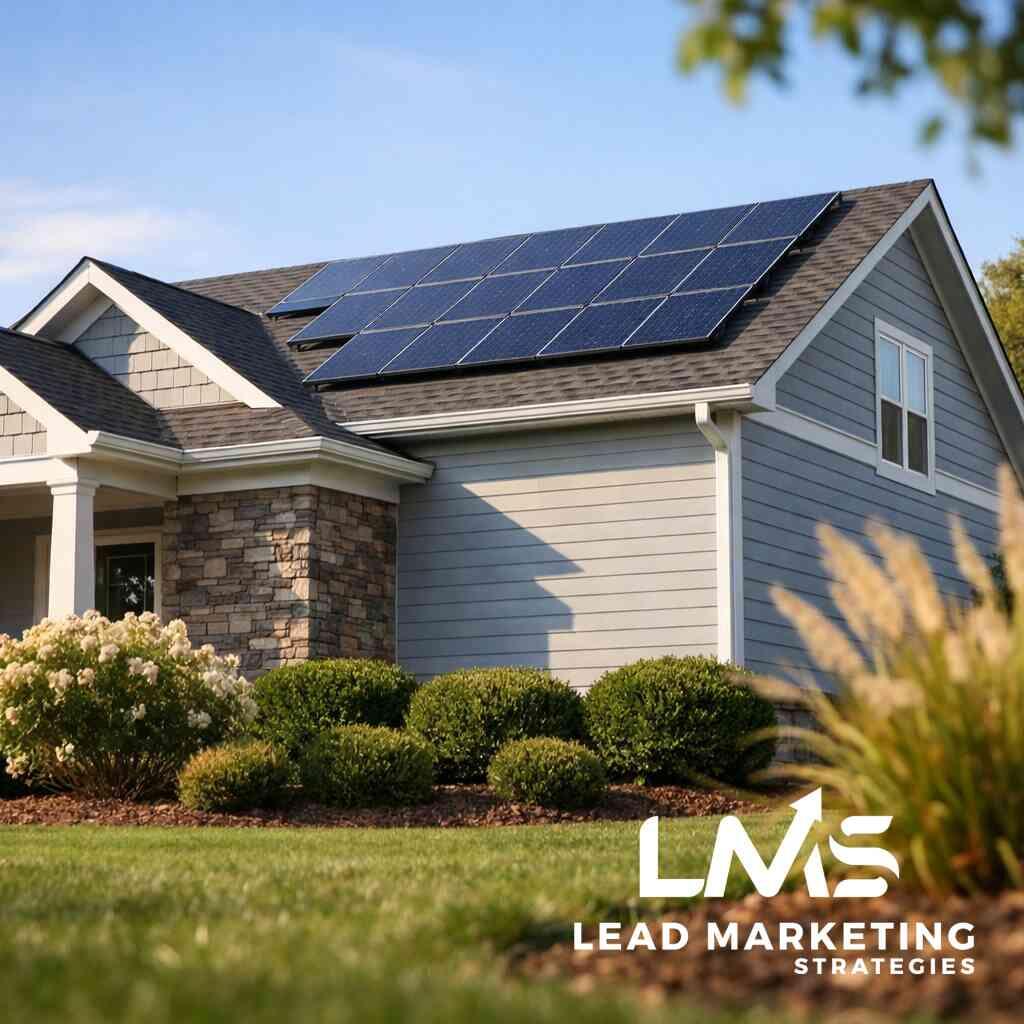
How to build solar search intent analysis around residential solar marketing keywords, commercial solar marketing keywords, and utility-scale solar marketing keywords
Start by dividing your market into three buckets: residential, commercial, and utility-scale. Each has different questions, deal sizes, timelines, and proof points. Residential solar marketing keywords usually focus on bills, financing, and roof suitability. Commercial solar marketing keywords care more about payback, tax treatment, and operational savings. Utility-scale solar marketing keywords often revolve around land use, grid interconnection, and project finance.
Intent typeTypical keyword examplesBest page typeSales cycleResidentiallocal solar SEO keywords, solar panel marketing keywords, solar installer advertising keywordsservice page or city pageshort to mediumCommercialcommercial solar advertising, solar contractor SEO keywords, solar marketing ROI keywordsindustry page or case studymedium to longUtility scalesolar service area keywords, renewable energy marketing keywords, clean energy advertising keywordscapability pagelongThis is also where geo-targeting matters. Local solar SEO keywords work differently in Long Island than in Phoenix, and a service area keyword set for Commack will not look the same as one built for Texas or California. The searcher’s urgency changes with utility rates, roof stock, and incentive awareness.
If you want to go deeper on intent mapping, I point teams to our solar market research guide and to the U.S. Census business data when sizing commercial opportunity by market.
The clustering method for solar keyword research that powers solar SEO keyword strategy and keyword mapping for solar websites
Clustering means grouping related terms so one page can rank for many searches without becoming bloated. In my experience, this is the most efficient way to build a solar SEO keyword strategy. We often use a HubSpot-style pillar-and-cluster model, then adapt it to solar taxonomies like financing, incentives, installation, maintenance, and reviews.
A clean clustering method looks like this:
- Pick one core topic, such as solar lead generation.
- Group close variants, including solar lead gen strategies, solar conversion keyword optimization, and solar landing page keyword strategy.
- Assign one primary page and several support pages.
- Map each cluster to a funnel stage.
- Keep each page focused on one buyer question.
That process helps avoid keyword cannibalization, where multiple pages compete for the same phrase. It also makes your site easier to scale. If you need proof that content structure matters, Google’s SEO Starter Guide is a useful baseline, and we also tie content planning to content marketing for solar companies when a cluster needs deeper educational support.
On a recent project, a commercial installer in a dense metro area had six pages chasing the same phrase. We collapsed them into one pillar and three support pages. Rankings improved, but more importantly, sales got better leads because the pages finally matched the search intent.
If you are building this from scratch and want help, Solar Marketing Strategies is a strong fit for solar-specific SEO, ads, and conversion work. We focus on the solar sales cycle, not generic local traffic, which is why our work tends to hold up better once the leads start coming in.
Frequently Asked Questions
Question: What is the best solar keyword research process for building a stronger solar SEO keyword strategy?
Answer: The best solar keyword research process starts with solar intent-based keyword targeting, not search volume alone. At Solar Marketing Strategies, we begin by sorting keywords into buyer-intent groups like residential solar marketing keywords, commercial solar marketing keywords, and utility-scale solar marketing keywords, then we evaluate search volume, keyword difficulty, and conversion potential. That allows us to build keyword mapping for solar websites that connects each term to the right page, offer, and call to action. We also look for low competition solar keywords and high intent solar keywords that can drive qualified traffic instead of random clicks. This approach supports better solar marketing ROI, lower cost per lead solar performance, and a more efficient solar SEO keyword strategy overall.
Question: How does solar keyword research help reduce wasted spend in solar PPC keyword research and Google Ads for solar companies?
Answer: Solar keyword research is one of the fastest ways to improve paid search efficiency because it helps you avoid broad terms that attract the wrong audience. For Google Ads for solar companies, we focus on solar PPC keyword research that separates homeowners, business owners, and research-only searchers so your ads only show for people likely to request a quote. We build solar PPC keyword lists around solar lead generation keywords, solar contractor SEO keywords, and solar landing page keyword strategy terms that match specific services and locations. That means less budget wasted on irrelevant clicks and more spend directed toward users who are actually ready to talk to a solar company. When we combine that with a strong landing page and a clear solar sales funnel, cost per lead solar metrics usually improve quickly.
Question: What is solar search intent analysis, and why does it matter for residential solar marketing keywords and commercial solar marketing keywords?
Answer: Solar search intent analysis is the process of identifying what the searcher really wants before choosing the keyword or writing the page. A homeowner searching residential solar marketing keywords usually wants savings, financing, installation timelines, and local trust signals, while someone using commercial solar marketing keywords may care more about payback, incentives, tax treatment, and project scale. If you treat those searches the same, your messaging becomes too generic and your leads get weaker. At Solar Marketing Strategies, we use solar search intent analysis to separate residential, commercial, and utility-scale demand so each page speaks to one buyer type. That is how we improve solar website SEO keywords, reduce keyword cannibalization, and create pages that support real conversions instead of just traffic.
Question: How do you handle solar keyword clustering and keyword mapping for solar websites in the blog What Is the Best Solar Keyword Research Process?
Answer: In the blog What Is the Best Solar Keyword Research Process, the main idea is that clustering keywords by topic creates a cleaner, stronger content structure. We use solar keyword clustering to group related terms such as solar lead gen strategy keywords, solar conversion keyword optimization, solar content marketing keywords, and solar landing page keyword strategy terms into focused topic buckets. Then we assign each cluster to a single page with one primary goal, which helps with keyword mapping for solar websites and prevents multiple pages from competing for the same query. This approach is especially useful for solar web design because the structure of the page should match the intent of the keyword. When done well, it improves rankings, strengthens internal linking, and makes the site easier for visitors to navigate and trust.
Question: Can Solar Marketing Strategies help with local solar SEO keywords, Long Island solar marketing keywords, and Commack NY marketing agency keywords?
Answer: Yes. Solar Marketing Strategies works with both local and nationwide solar companies, and we know how location affects keyword strategy. Local solar SEO keywords, Long Island solar marketing keywords, and Commack NY marketing agency keywords all carry different levels of urgency, competition, and buyer intent. We build geo-targeted solar keywords and solar service area keywords around the actual market, not just the city name, so the content fits the local audience and the local search environment. That is especially important for solar company marketing because homeowners and businesses want providers they can trust in their region. By combining local optimization with solar digital marketing, solar content marketing, and solar web design, we help companies show up where qualified leads are searching.
Question: What solar marketing services do you recommend beyond keyword research to improve solar marketing ROI?
Answer: Keyword research is the foundation, but the best results come when it is paired with the right solar marketing services. We usually recommend a combination of solar search engine optimization, solar PPC, solar web design, solar content marketing, and solar social media so the entire funnel works together. For example, solar panel marketing keywords and solar installer advertising keywords should guide the ad copy, landing page, and follow-up content, while solar email marketing and solar referral programs can help move leads closer to a decision. We also look at solar marketing case studies, solar marketing trends 2025, and solar marketing ROI benchmarks to refine the strategy over time. When the full system is aligned, it becomes much easier to lower cost per lead solar numbers and generate consistent solar lead generation.
Every article is written by one of our founders and independently reviewed by the other before it goes live.

Ken Key is the Chief Technology Officer and Co-Owner of Solar Marketing Strategies. He engineers the technical systems, SEO, and tools that help solar installers attract and convert homeowners. He and his wife Dominique run the company as a family business, bringing both creative and data-driven care to every campaign.

Dominique Key is Chief Marketing Officer and Co-Owner of Solar Marketing Strategies, a family-run agency helping solar installers connect with homeowners who are ready to go solar. She guides brand strategy, visual identity, and client experience with a warm, down-to-earth style. She co-runs the agency with her husband, Ken Key, blending personal attention with practical marketing know-how.