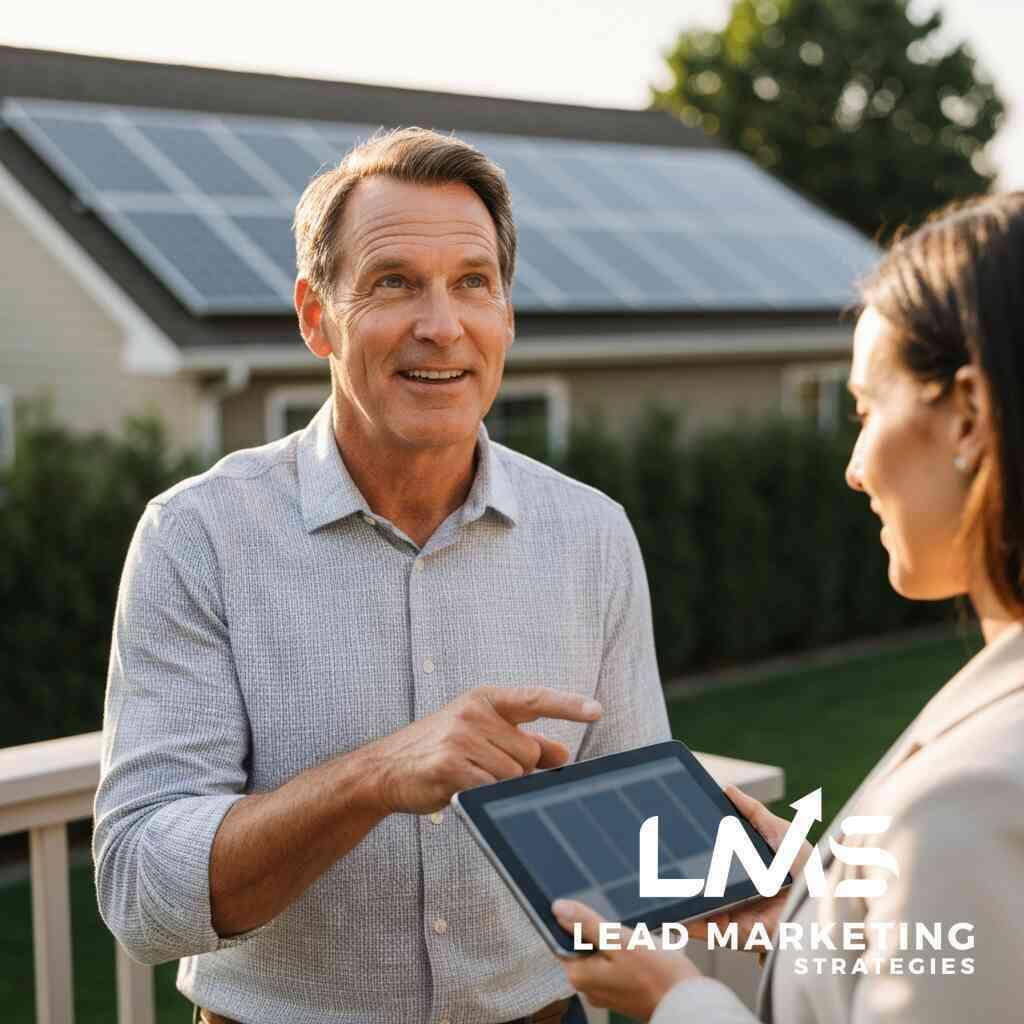
Solar Referral Marketing: How to Build Referral Loops That Keep Producing Leads
Most solar companies treat referrals like a lucky break. A happy homeowner mentions you to a neighbor, and you send a gift card. That is a referral program. It is not a referral loop.

A referral loop is different. It is a system where every new customer becomes a new advocate, and every advocate brings in customers who become advocates themselves. Solar referral marketing done well compounds over time. Done poorly, it is a stack of gift cards and a spreadsheet nobody updates.
Here is the short answer: Build a solar referral loop by making advocacy effortless, rewarding it in tiers tied to real milestones, and automating the ask at the exact moment a customer feels the most trust in you. Layer in hyper-local outreach, digital payouts, and tracking that measures how fast each referral produces the next one. That is the whole game.
We work with solar businesses every day, and in our experience the companies with the lowest customer acquisition cost are almost never the ones spending the most on ads. They are the ones whose customers do the selling for them.
Why Does Word-of-Mouth Still Beat Paid Ads for Solar in 2026?
Because homeowners do not trust solar ads. They trust their neighbor’s electric bill.
Solar is a high-ticket, high-scrutiny purchase. A homeowner is being asked to sign a 20 to 25 year agreement, let strangers on the roof, and bet on net metering incentives staying intact. That is a lot of perceived risk. Paid search and social ads can create awareness, but they rarely close the trust gap on their own.
Peer validation does. When someone on the same street with the same utility company and the same roof pitch says “we did this and here is what our production looks like,” the objection list collapses.
This is why word-of-mouth solar marketing remains the highest-converting channel in the category. It is also why smart operators treat referral generation as a core acquisition strategy rather than a nice-to-have. If you want to see how referral and organic channels pull down blended acquisition cost, our breakdown of how solar marketing strategies lower cost per lead walks through the math.
What Is the Difference Between a Referral Program and a Referral Loop?
A referral program is one-directional. You ask, a customer refers, you pay, it ends.
A referral loop is circular. The referred homeowner gets onboarded into the same advocacy system, and within weeks they are generating referrals of their own. The output of one cycle becomes the input of the next.
The metric that separates the two is the virality coefficient. In plain terms: how many new customers does one customer eventually produce? Below 1.0, your loop shrinks. At 1.0, it sustains itself. Above 1.0, it grows on its own.
Most solar companies have never calculated this number. Start there. It will tell you more about your referral health than any dashboard.
How Do You Build a Solar Referral Program That Actually Works?
You build it around milestones, not signups. The mistake we see most often is paying out a flat reward the moment a name is submitted. That attracts low-intent leads, burns your team’s time, and rewards the wrong behavior.
Tier your rewards to real progress. Here is a structure that works well:
- Level 1, appointment booked: A free smart thermostat. Small enough to be an easy yes, useful enough to feel real.
- Level 2, contract signed: $500 cash back to the referrer plus $500 off the friend’s system. The dual-sided reward matters. It removes the awkwardness of asking a neighbor for a favor.
- Level 3, third successful referral: A free EV home charger or a year of complimentary system monitoring and maintenance. This is where you create your true brand advocates, the people who keep referring because the relationship keeps paying them back.
Notice what the tiers do. They reward the referrer for quality, not volume. They give the referred homeowner a reason to say yes. And they create a natural ladder that keeps your best advocates engaged long after installation day.
What Is the Average Reward for a Solar Referral?
In our experience, most solar companies land somewhere between $250 and $1,000 per closed referral, with many splitting the reward between the referrer and the new customer. Cash is the most common, but non-cash rewards like EV chargers, monitoring plans, and smart home devices often produce better retention because they keep your brand in the customer’s daily life.
Do not anchor to an industry average, though. Anchor to your customer lifetime value. If a closed solar job is worth several thousand dollars in margin to you, a $500 reward is not expensive. It is one of the cheapest acquisition costs you will ever pay.
How Do You Make Referring Effortless?
You remove every step that requires the customer to think.
Friction is the silent killer of solar referral marketing. A homeowner who has to log into a portal, find a referral code, copy it, text it to a neighbor, and then chase that neighbor to make sure they used the code will simply not do it. Not because they are ungenerous. Because life is busy.
Fix it with three things:
- One-tap sharing. A link or SMS template the customer can forward in under five seconds.
- Automated tracking. The referral is attributed without the customer doing anything. No codes to remember.
- Instant payout. The moment the referred system passes inspection, the reward lands in the referrer’s Venmo, PayPal, or Apple Pay. Not a check in six to eight weeks. Immediately.
That last point matters more than most companies realize. Instant digital payouts turn a reward into an event. The customer gets a notification, feels the win, and is far more likely to refer again. Delayed paper checks feel like paperwork.
How Do You Automate Solar Referral Loops?
You connect your CRM, your SMS platform, and your payout system so the ask happens without anyone remembering to make it.
Here is the sequence we typically recommend. It runs on triggers, not on someone’s to-do list:
- Day of activation: Automated text and email with the customer’s production data and a one-tap referral link. This is the peak-trust moment. Use it.
- Day 30: Follow-up with a personalized digital toolkit they can share in local groups. More on that below.
- Day 90: A check-in message with their savings-to-date and a soft nudge to share.
- Every closed referral: Automatic payout plus a thank-you message that shows their next tier reward.
Your solar CRM does the heavy lifting here. HubSpot, Salesforce, and the solar-specific platforms all support referral tracking, but the configuration is what separates a working loop from a dead workflow. If your CRM cannot tell you which customer referred whom, when, and at what stage, you do not have referral tracking. You have a contact list.
Pair this with email marketing built for solar and automated SMS, and the loop runs whether or not anyone on your team is thinking about it.
Best Solar CRM With Built-In Referral Tracking
We do not sell software, so here is the honest version. HubSpot handles referral tracking well if you build custom properties and workflows. Salesforce gives you the most flexibility if you have someone to configure it. Solar-specific CRMs like Enerflo and similar platforms come with referral fields out of the box but vary widely in automation depth.
The right answer depends on your volume. Under a few hundred installs a year, a well-configured HubSpot setup will do everything you need. Above that, invest in a platform that tracks referral conversion rate and loop velocity natively. What matters is that the data lives in one place and triggers fire automatically.
How Can Solar Companies Get More Word-of-Mouth Leads Without Buying Lists?
By turning installed customers into distribution.
This is the tactic we see work best, and almost nobody does it well. When a system goes live, equip the homeowner with a personalized digital toolkit. Not a generic brochure. A custom landing page or SMS template that includes their real production data and their referral link.
Now that homeowner can post in their neighborhood Facebook group, Nextdoor, or a local WhatsApp thread and say, “Here is what our system produced last month, and here is the link if you want a quote.” That is social proof with receipts. It converts at a completely different level than a testimonial page.
We call these neighborhood blasts, and they work because they are hyper-local and specific. A homeowner two streets over sees real numbers from a real roof in their own zip code.
The Nodal Referral Strategy
Every community has nodes. People others listen to. Not traditional influencers with follower counts, but the HOA president, the eco-conscious neighbor who organizes the farmers market, the local roofing contractor everyone trusts.
Identify those people and bring them into your loop deliberately. A roofing contractor who refers you consistently is worth more than any ad campaign. An HOA president who hosts a solar Q&A in the community room can seed an entire subdivision.
This is where social media marketing that builds local trust earns its keep. You are not chasing reach. You are finding and nurturing the handful of people whose recommendation moves your market.
How Do You Measure Loop Velocity?
You track how fast a new customer generates their first referral.
That single number tells you whether your loop is healthy. If customers refer within 30 days of activation, your onboarding and ask timing are working. If the average is 180 days, your ask is arriving too late or not at all.
Track these alongside it:
- Referral conversion rate: referred leads that become closed jobs, compared to your other channels
- Referrals per customer: your virality coefficient in practice
- Cost per closed referral: reward cost plus platform cost divided by closed jobs
- Referrer retention: how many advocates refer more than once
Run these against your customer lifetime value and your solar customer acquisition cost. When referral CAC comes in well below paid CAC, you know exactly where to reinvest. Our team goes deeper on this in our guide to improving solar conversion rates.
One more thing worth saying. Referrals are a reputation channel as much as an acquisition channel. If your install quality or follow-up is inconsistent, a referral loop will amplify the problem just as fast as it amplifies the good. Keep an eye on reputation management so your advocates are recommending something worth recommending.
Frequently Asked Questions About Solar Referral Marketing
How many referrals should a solar company expect per customer?
It varies widely by market and by how well the loop is built. In our experience, companies with a mature, automated referral system see a meaningful share of new business come from referrals, while companies without one see almost none. The gap is process, not product.
Should referral rewards be cash or non-cash?
Both have a place. Cash and digital wallet payouts drive immediate action. Non-cash rewards like EV chargers, monitoring plans, and smart thermostats tend to strengthen the long-term relationship and keep your brand visible. A tiered mix usually outperforms either alone.
How do we prevent referral fraud?
Tie payouts to verified milestones, not submissions. A reward that only pays when a contract is signed and the system passes inspection is nearly impossible to game. Automated tracking through your CRM closes the remaining gaps.
Do referral loops work for commercial solar too?
Yes, though the mechanics shift. Commercial referrals tend to run through professional networks, trade associations, and facility managers rather than neighborhood groups. The tiered structure still applies, but the rewards and the ask timing need to match a longer sales cycle. Our team covers that in more depth in our commercial solar marketing guide.
Ready to Turn Your Customers Into Your Best Lead Source?
Referral loops are not complicated, but they are easy to get wrong. The reward structure, the automation, the ask timing, and the tracking all have to line up. When they do, your customers do the acquisition work for you at a fraction of what paid channels cost.
If you want help building this inside your solar business, our team can map the whole system with you. You can book a free consultation and we will walk through your current referral flow, your CRM setup, and where the loop is leaking. Prefer to talk it through? Call us at (833) 532-3100.
And if you want to keep an eye on your pipeline from anywhere, download our mobile app. It is available for iOS here and Android here. We would love to help you build a referral engine that keeps producing long after the install is done.
The Solar Marketing Strategies Team
Our team of marketing experts specializes in helping solar businesses grow their businesses through strategic digital marketing, SEO, and customer acquisition.
View all articles